Quick Start
blind_transpiler is an open source qiskit-based library for rapid prototyping of quantum homomorphic encryption and universal blind quantum computation in circuit-based model.
Install:
The blind_transpiler library can be installed using pypi as:
pip install blind-transpiler
Create your first blind circuit:
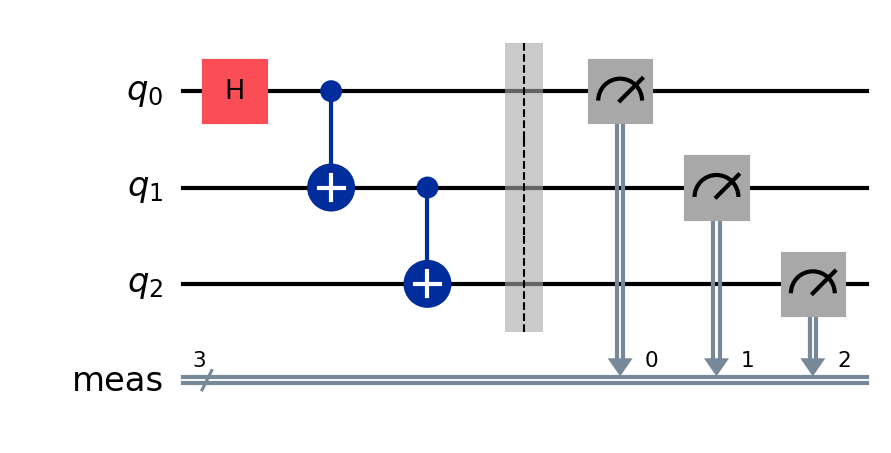
Let’s take a simple circuit of GHZ state:
from qiskit import QuantumCircuit

qc = QuantumCircuit(3)

qc.h(0)

qc.cx(0,1)

qc.cx(1,2)

qc.measure_all()
The circuit will be given as:
Let us also define a simulator for the circuit:
def run_circuit(circ):

    backend = AerSimulator()

    shots = 1000

    t_circ = transpile(circ, backend)

    results = backend.run(t_circ, shots=shots).result()

    return results
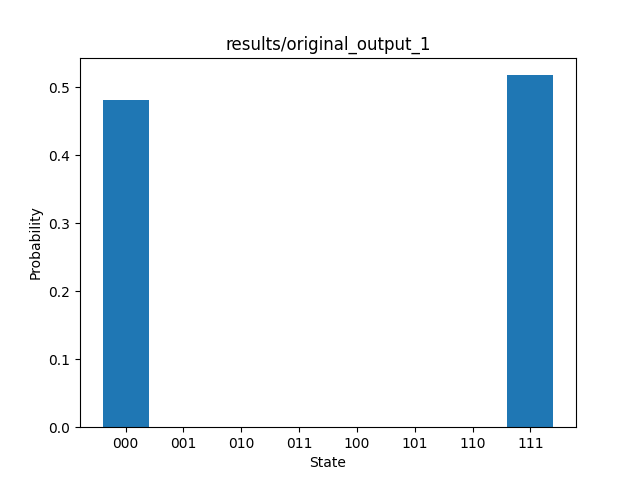
If we run the circuit of GHZ state defined above on the qiskit simulator, we will see the output as:
This circuit can be converted to its equivalent blind circuit using blind_transpiler library as:
from blind_transpiler import BQC

bqc = BQC()

bqc_instructions = bqc.generate_bqc(circ=qc, format='qhe')
This bqc_instruction objects contains the sequence of gate and the instruction to delegate then in the client-server architecture. We can try four different format, namely, qhe, ubqc, fdqc, ssdqc.
For more control on the encryption process, we can explicitly estimated the size of encryption key and generate it using any random process, or library defined process as:
from blind_transpiler import BQC

bqc = BQC()

key_size = bqc.estimate_keysize(format='qhe', circ=qc)

keys =  bqc.generate_random_key(key_size=key_size, key_style='rand')

bqc_instructions  = bqc.generate_bqc(circ=circ, format ='qhe', keys=keys)
The object bqc_instructions can be probed to get the various parameters associated with delegation as:
print(bqc_instrucion.n_client_gates)

print(bqc_instrucion.n_server_gates)

print(bqc_instrucion.n_secure_gates)

print(bqc_instrucion.n_communication_rounds)
The object bqc_instructions is virtually a collection of modified gate object which can be further probes for additional information as:
for elem in bqc_instructions:

    print(elem.op_type)

    print(elem.conditional)

    print(elem.gate)
Here, op_type defines the type of operation that the given instruction perform. For instance, it can be a client operated gate, or server delegated gate, or it might be gate necessary for encryption or decryption. conditional give the value of boolean variable which can be $0$, meaning the gate in not needed in final conversion or $1$, gate is needed in final execution based on the encryption key given. gate is the object of Qiskit instruction class which will actually be appended if the circuit is delegated to the server.
The object bqc_instructions can further be use to simulate the result be generating Qiskit circuit for this objection
blind_circ = bqc_instructions.to_circuit(const_type='complete', show_barrier=True)
This will result in a quantum circuit written in Qiskit, which in our case will look like:
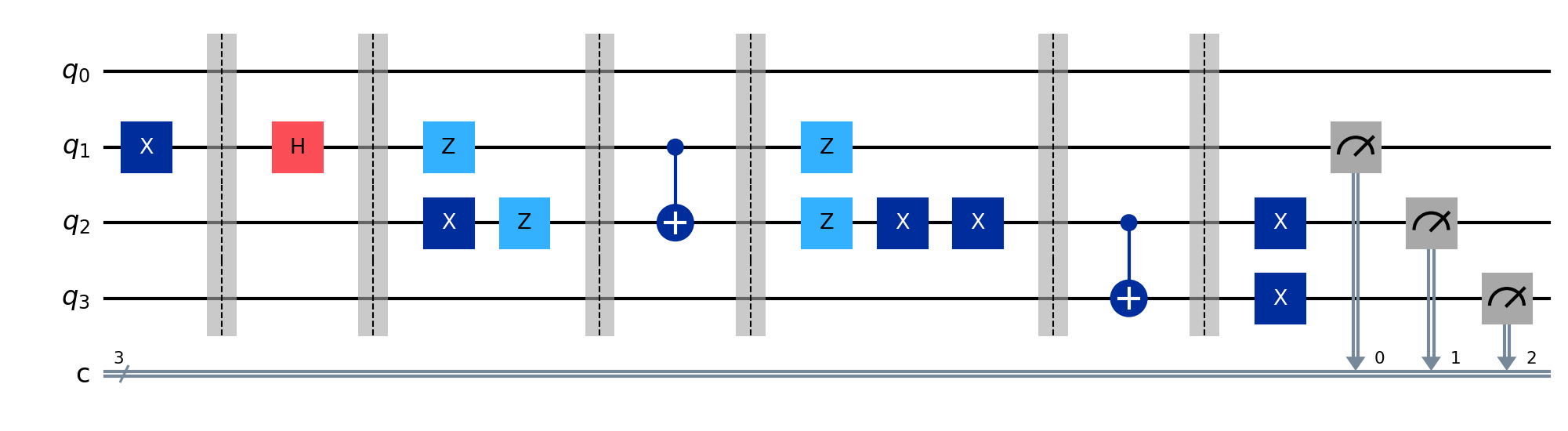
This circuit when simulate over client-server architecture will result in the output as desired by original circuit:
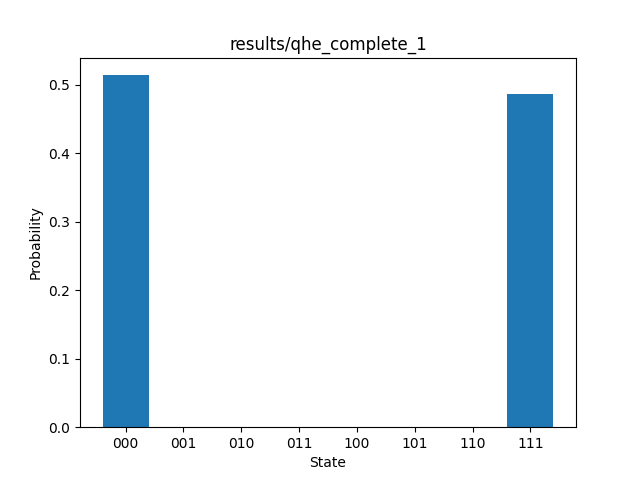
However, if we delegate the circuit without proper decryption, we will get output unrelated to the original output. The output can be generated over $1000$ random key values as:
blind_format = 'qhe'

const_type = 'encrypt_only'

n_samples = 1000

bqc_trial = BQC()

estimated_key_size = bqc_trial.estimate_keysize(format=blind_format, circ=qc)

random_sample_key_space =  generate_binary_samples(n_samples,estimated_key_size)

n_clbits = circ.num_clbits

output = {output_key: 0 for output_key in [format(i, f'0{n_clbits}b') for i in range(2**n_clbits)]}

for keys in tqdm(random_sample_key_space):

    blind_circ, _ = blind_transpiler(circ=circ,blind_format=blind_format, const_type=const_type, keys=keys)

    results = run_circuit(blind_circ).get_counts()

    for k in results.keys():

        output[k] = results[k]

return output
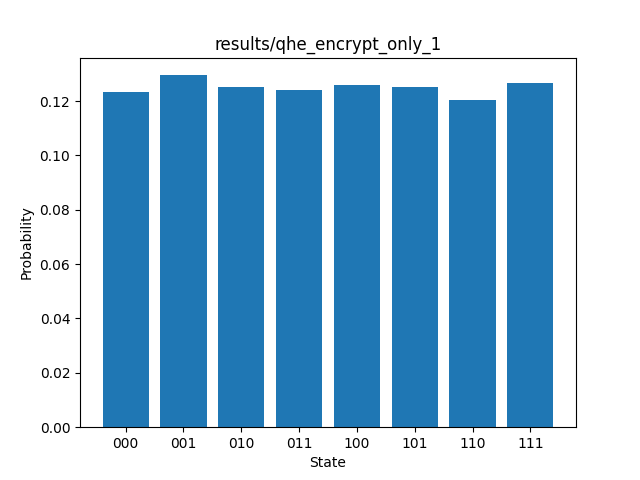
The output over $1000$ random keys will be: